
What are your tax needs?
(And what type of structure will satisfy them?)
Take a look at the chart below to determine when you should opt for a Tax Lease or when it would be best to choose an Equipment Finance Agreement (EFA) or Capital Lease.
Pro tip: You should always review your own unique situation with your tax advisor. They know your situation best!
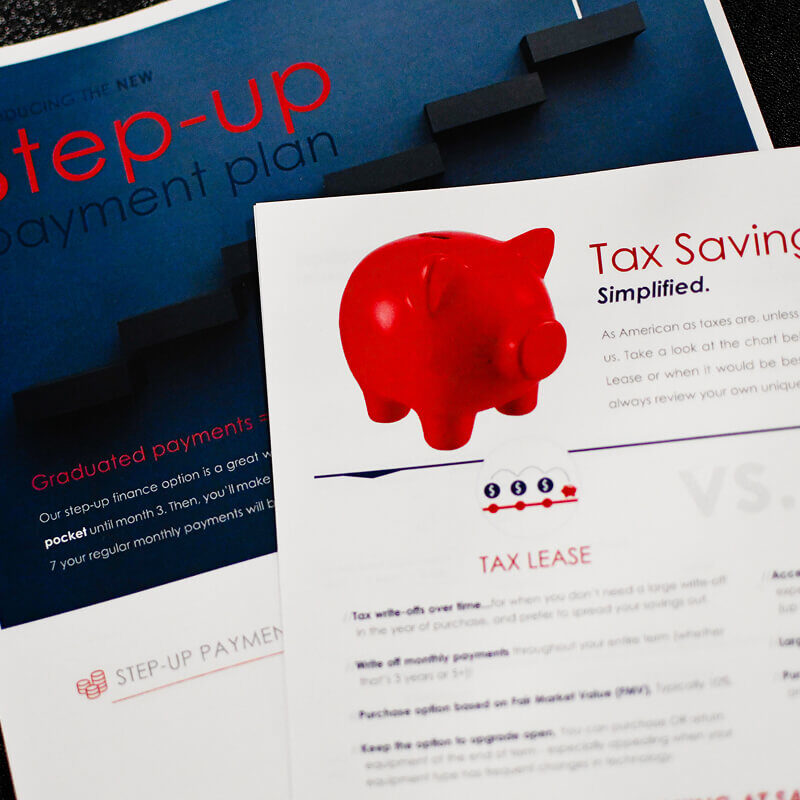
| Tax Lease | EFA or Capital Lease | |
|---|---|---|
| Savings Timeline | Write-offs over time. Choose this option when you don’t need a large write-off in the year of purchase but want to spread savings out over time. | Accelerated savings. You may be able to expense 100% of the cost of equipment in the year it was purchased (up to the max threshold). |
| Type of Deduction | Deduct payments. | Section 179 or standard depreciation. |
| Deduction Size | Write off monthly payments throughout your entire finance term. 36-month term? Write off payments for 3 years. 60-month term? Write them off for 5 years! | Larger tax savings up-front. Take the entire deduction via Section 179 this year vs. writing off payments over time. |
| End of Term | Purchase or upgrade. Most Tax Leases are set up with a 10% purchase option at the end of term. You can pay this to own the equipment outright or keep the option to upgrade to the latest model open. As always, no early pay-off penalties. | You own the equipment after the last payment. There’s usually not a buyout unless you initially set it up that way. No early pay-off penalties. |
How much could you save?
The calculator below will give you a great estimate of how much you could save with each finance option. Just remember that all calculations are for illustrative purposes only and will vary based on credit and individual financial situations.
TAX LEASE
EFA
Heads up! There are several factors that can affect the payments and deductions in the calculations above. If you'd like a more accurate estimate, request a free payment quote below.
> Apply for financing
The calculations above are for illustrative purposes and based on excellent credit. Actual monthly payments will vary. Tax savings are assuming a 35% tax bracket and are unique to your own situation (we recommend consulting your tax advisor).

Get a free, custom quote!
With a little bit of information from you, our team will calculate customized monthly payments so you can weigh your options and consult your tax advisor. There's no cost to request a payment quote and no obligation to finance with us. When you're ready, we'll be here.
What is Section 179 and how does it benefit me?
Section 179 is a great way to accelerate your tax benefits. With this deduxtion, you may be able to expense 100% of the cost of equipment acquired and put into use in 2026, up to $2,560,000. (In 2025, the deduction limit was $2,500,000.) Depending on your tax bracket, you could save a portion of that equipment cost in tax savings.
To take advantage of the deduction, we can structure you with a Capital Lease or Equipment Finance Agreement (EFA), which is smilar to a loan. At the end of term, the equipment must be purchased (or the lease renewed) to be eligible for this deduction. Equipment cannot be returned.





Tax questions? Just ask!
As American as taxes are, unless you’re a CPA the details are still Greek to most of us. If you have questions, don’t hesitate to ask us! We’ll do our best to answer basic inquiries about tax savings and what option could be best for you. If your question is specific to your business, it’s probably something your tax advisor can answer more thoroughly than us.